
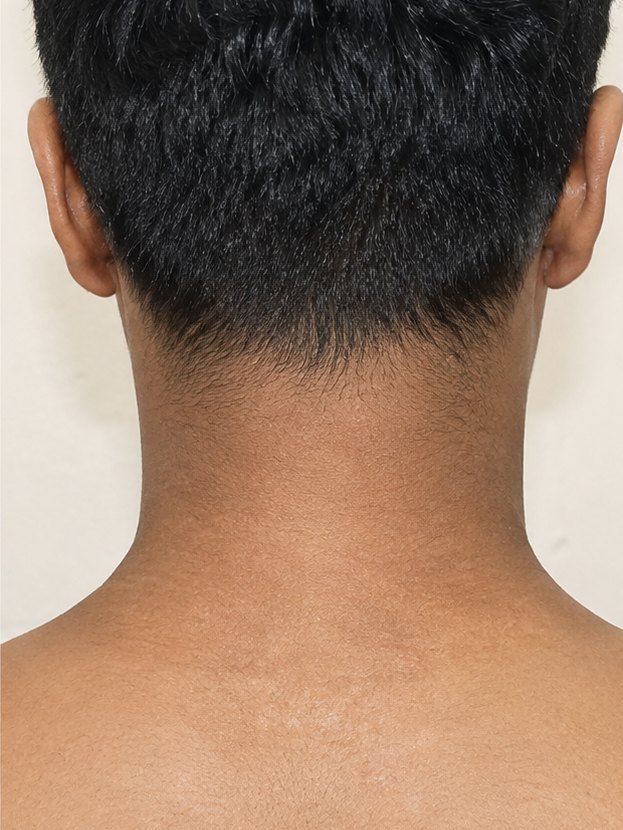
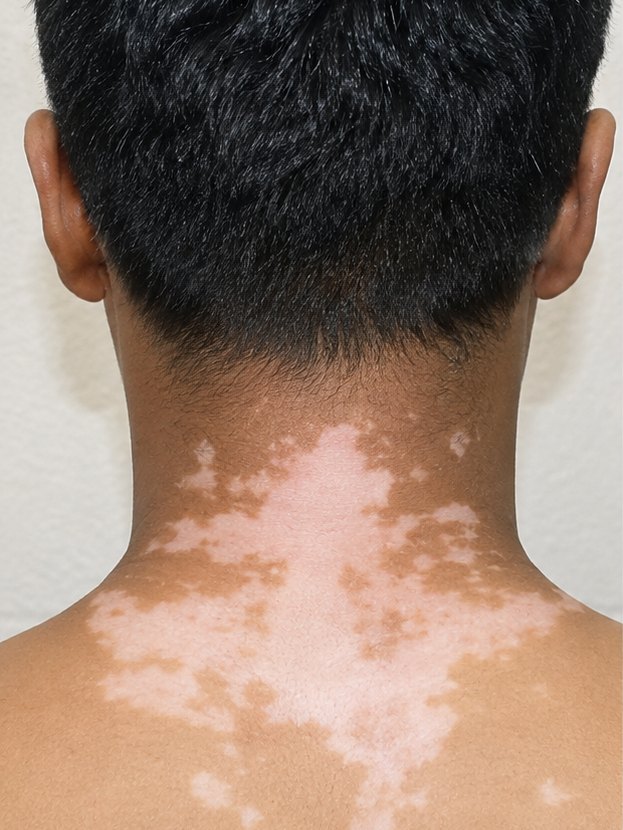

Neck & upper back
- Age
- 24 · Male
- History before treatment
- 2 years, actively spreading
Trunk and neck patches sit over dense follicles and a rich blood supply, which is why they respond faster than anywhere else on the body.
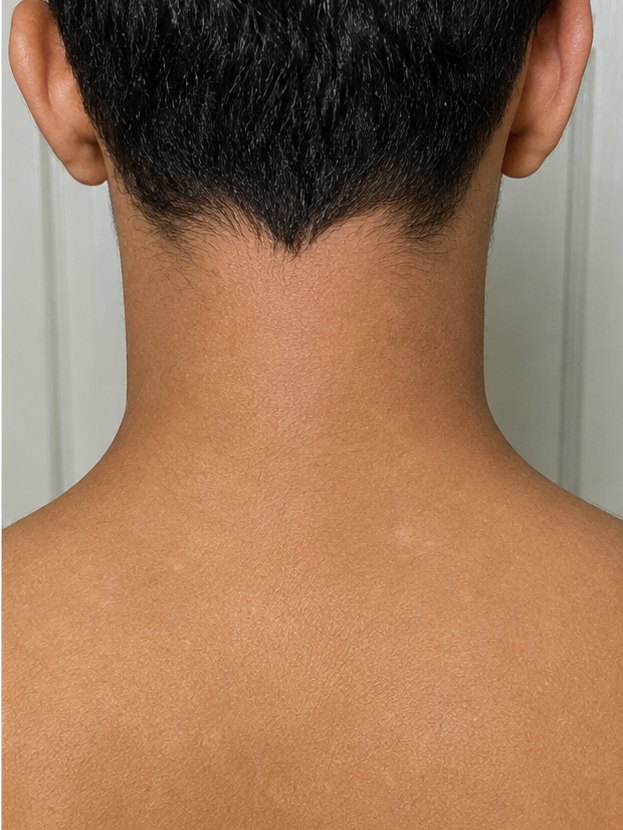
For over ten years, vitiligo has been the condition this clinic is known for. A root-cause Ayurvedic protocol that first halts the spread, then works to bring your natural pigment back — supervised by a qualified physician, not sold over a counter.
No cost. No obligation. Takes 2 minutes.

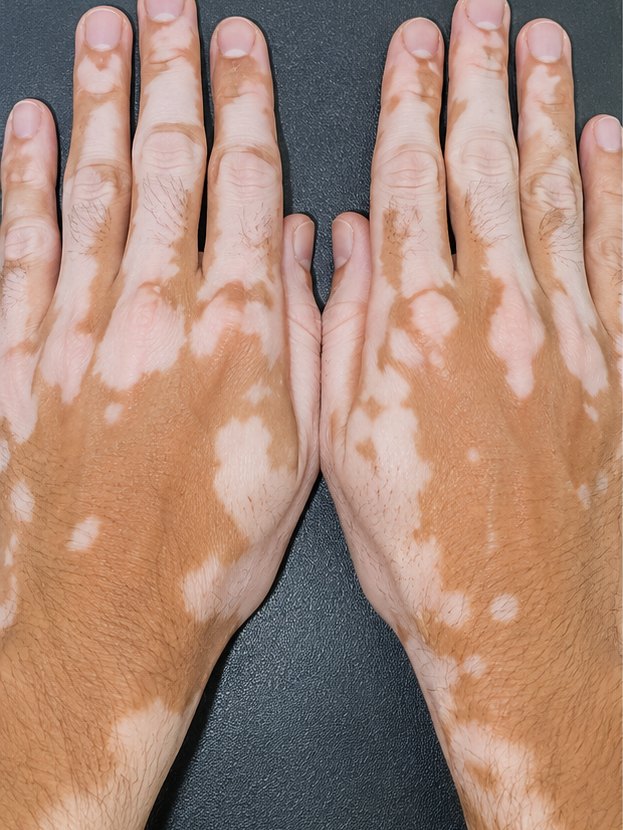
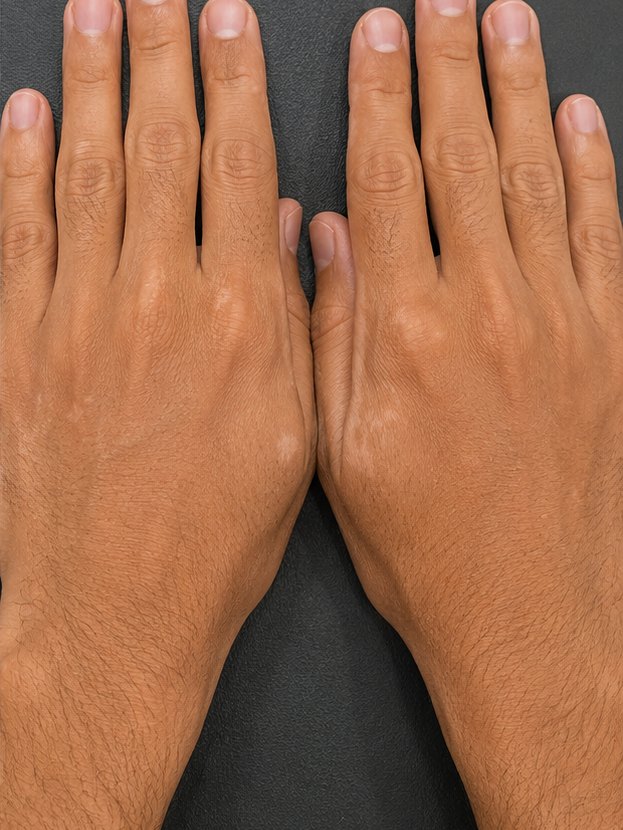
Patches on the hands — the slowest area on the body to respond
Most people who come to us have already seen three or four doctors. They have been told to 'apply this cream and wait'. Here is what nobody wrote in the file.
Measuring the edge. Wondering if it grew overnight. That daily inspection is exhausting, and it is the first thing our patients tell us stops.
It started somewhere you could hide. Now it is on your hand, your neck, your face — and clothing no longer solves the problem.
Weddings, interviews, first dates, family photos. The condition is on your skin, but the withdrawal happens in your life.
They worked for a while, then plateaued — and the skin around the patch is now thin, shiny or stretched from long-term use.
In Indian families this question lands hard and lands early. We hear it in almost every consultation.
You were handed a tube and a name. No one told you what triggered it in your body, or what is keeping it going.
If you recognised yourself in three or more of these, keep reading.
Vitiligo is not a skin disease that happens to be on your skin. It is an internal, auto-immune process that becomes visible on your skin. Treat only the surface and it returns.
Melanocytes — the cells that make your skin colour — are being destroyed by your own immune system. A cream applied on top cannot reach the cells doing the destroying. Until that internal attack is calmed, new patches keep appearing.
In Ayurveda this is agni-mandya and the resulting ama — metabolic toxins from incomplete digestion that circulate and inflame. This is why two patients with identical patches need completely different medicines: their digestion is different.
Typhoid, a surgery, a bereavement, a pregnancy, exam pressure, a bad year at work. Almost every patient can name the six months when it began. Remove the trigger loop and the condition loses its momentum.
This is why our protocol works from the inside outward — digestion first, immunity second, pigment last. In that order, and never the reverse.
Read moreEvery photograph below was taken at our clinic under fixed lighting, published with written consent, and labelled with the honest treatment duration — including the slow cases.


Trunk and neck patches sit over dense follicles and a rich blood supply, which is why they respond faster than anywhere else on the body.

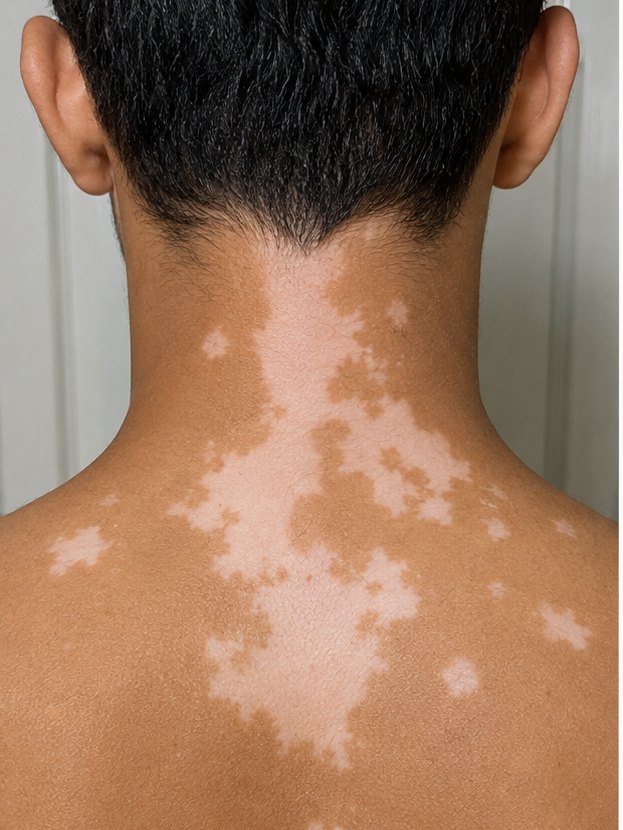
Spread halted in week 7. A faint outline remained at the shoulder where the patch had been longest.


Hands are among the slowest areas on the body — few follicles and constant friction. Eleven months for a partial close, and the fingertips remain lighter.
Photos published with written patient consent.
Vitiligo treatment fails when it is rushed. Here is exactly what happens, in order, and roughly how long each stage takes.
You send photos of every patch and answer a detailed history questionnaire. We tell you honestly whether you are a good candidate — and if you are not, we say so. Free, and there is no obligation afterwards.
A full consultation with the doctor: prakriti (constitution) analysis, nadi pariksha, digestive assessment, trigger mapping, and blood work — thyroid, B12, vitamin D and anti-TPO antibodies. Vitiligo travels with other auto-immune conditions and we look for them.
The first goal is never repigmentation. It is stopping the advance. Internal medicines correct digestion and calm the immune response, supported by a diet protocol built around your specific triggers. Most patients see the edges stabilise in this window.
Once the spread is controlled we begin active pigment work — customised internal formulations, Bakuchi-based external preparations, and controlled, timed sun exposure. Colour returns first as small brown dots inside the patch, spreading outward from the hair follicles.
Medicines are tapered while immunity and digestion stay supported, so the patches do not return the moment treatment stops. You keep a maintenance diet and a review call every three months.

Most clinics in the district treat whatever walks in. Vitiligo is what this one is known for, and that focus is the reason the protocol is specific enough to work — a decade of cases, each one sharpening how the next is read.
You will speak to the doctor directly at every review. Not a coordinator, not a sales counsellor, not a call-centre executive reading from a script.


The spreading stopped in the second month. That alone let me sleep properly for the first time in two years. The colour coming back afterwards felt like a bonus I had stopped expecting.
Four dermatologists gave me the same steroid cream and nobody asked a single question about my digestion or my stress. Here the first consultation ran forty minutes before any medicine was even mentioned.
I live in Dubai and did the whole thing online. Photos every month, medicines couriered, video call every review. I never once needed to fly to India for it.
They told me upfront that my lip patches would be slow and might not fully close. That honesty is exactly why I trusted everything else they said.
Honestly: sometimes yes, sometimes partially, and occasionally not at all. Recent patches on the face, neck and trunk respond best — many close fully. Patches on the hands, feet and lips are slower and often reach partial repigmentation. Patches older than ten years, or skin where the hair has already turned white, respond least. We tell you which category you fall into at the free assessment, before you have spent anything.
Two different milestones. The spread typically slows between weeks 6 and 10 — that is the first thing to watch for. Visible repigmentation usually starts between months 3 and 5, appearing as small brown dots inside the patch rather than the whole patch darkening at once. Anyone promising results in three weeks is not describing vitiligo.
Yes, and many patients do. Tell us exactly what you are on — steroids, tacrolimus, phototherapy — and we build around it rather than against it. Never stop a prescribed medicine abruptly on your own; if tapering makes sense, we coordinate it properly.
Yes. The protocol runs on photographs, blood reports and phone or video consultations, and medicines are couriered anywhere in India. Patients from across Bihar, Jharkhand, Uttar Pradesh and West Bengal are followed up this way. What matters is the consistency of your monthly photos, not the distance to Nalanda.
It depends on the surface area involved and the formulations you need, so we will not quote a number before we have seen your case — that would be guesswork. The assessment is free, and you get the full cost breakdown in writing before you commit to anything.
Vitiligo caught in its first two years responds dramatically better than vitiligo caught in year six. Send us your photos today and find out exactly where you stand — it costs nothing.